





An Active Power Filter (APF) is a dynamic power quality management device based on modern microprocessors, digital signal processing technology, and a three-level topology. It can real-time detect harmonic currents and reactive components in the power grid, and actively output compensation currents with equal amplitude and opposite phase through IGBT power modules, thereby achieving precise filtering of the 2nd to 50th order harmonics (filtering capability better than 97% at rated load), reactive power compensation, and three-phase imbalance governance. With a response time of ≤ 10 ms and supporting 110% rated current for continuous operation, it provides an efficient power quality optimization and energy-saving solution for low-voltage distribution networks, substations, industrial automation, intelligent buildings, and data centers.
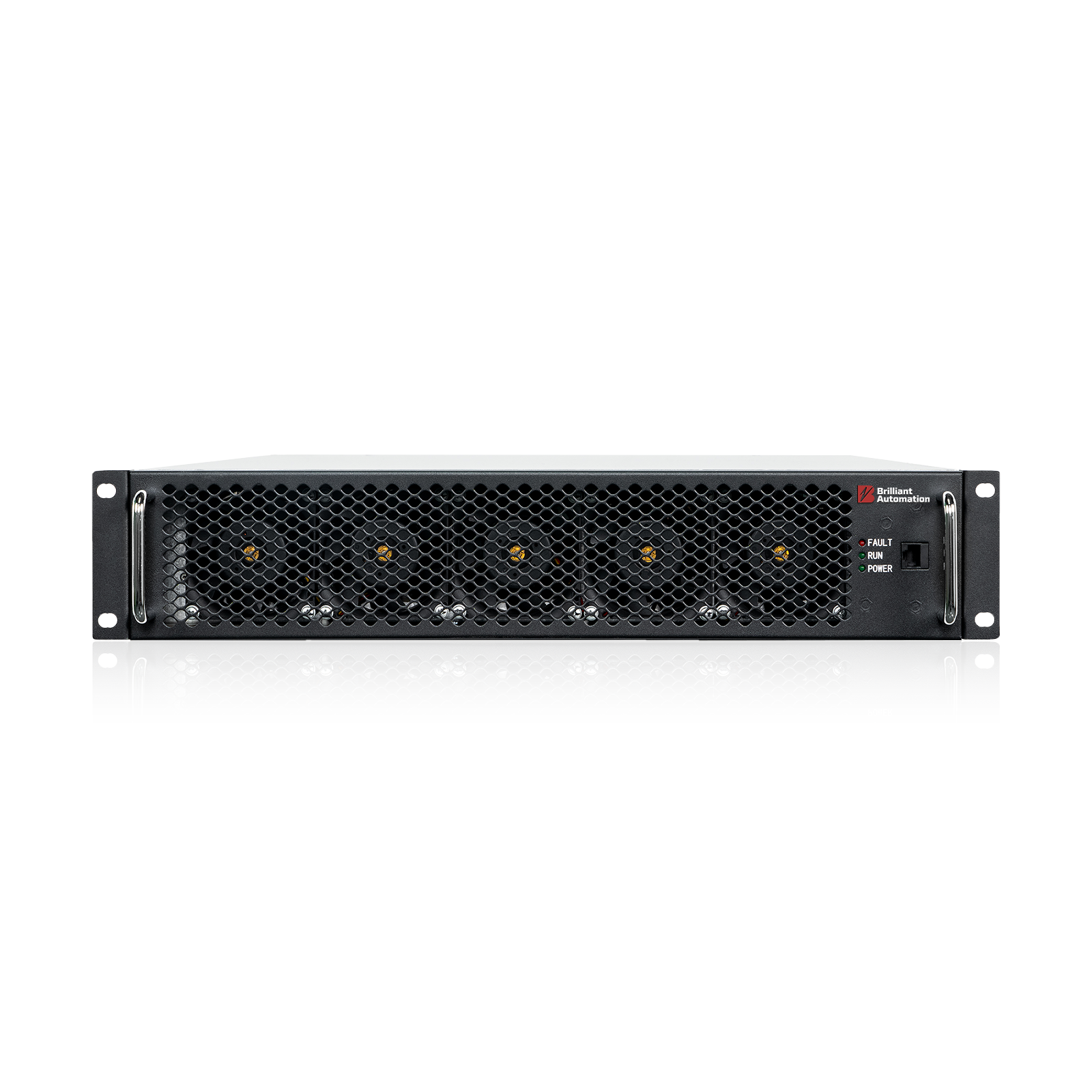
Power Quality
BRN-APF
The BRN-APF supports full-range harmonic mitigation, reactive power compensation, three-phase imbalance governance, and multi-unit parallel capacity expansion. It is highly suitable for precise power quality management and energy-saving applications in low-voltage distribution networks, substations, industrial automation, intelligent buildings, and data centers.
The BRN-APF series from Shanghai Brilliant Automation is a multifunctional Active Power Filter available in rack-mounted, wall-mounted, and vertical configurations. Utilizing a three-level topology and SMT components, it offers selectable 2nd to 50th order harmonic filtering (with filtering capability better than 97% at rated load), fast response within 10 ms, and 110% rated current continuous overload capability. The device automatically detects and records PT/CT disconnection and phase reversal, supports harmonic compensation, reactive power compensation, and three-phase imbalance governance, and provides flexible I/O expansion and multi-protocol communication (RS485/CAN) — making it highly suitable for substations, industrial automation, intelligent buildings, and data centers, and designed to support grid upgrades, harmonic mitigation, and refined energy management.
- Filtering & Compensation Performance: Selectable 2nd to 50th order harmonic filtering (filtering capability better than 97% at rated load), response time ≤ 10 ms, supporting reactive power compensation and three-phase imbalance governance.
- Overload & Topology: Three-level topology, supporting 110% rated current for continuous operation and 120% rated current for 1 minute.
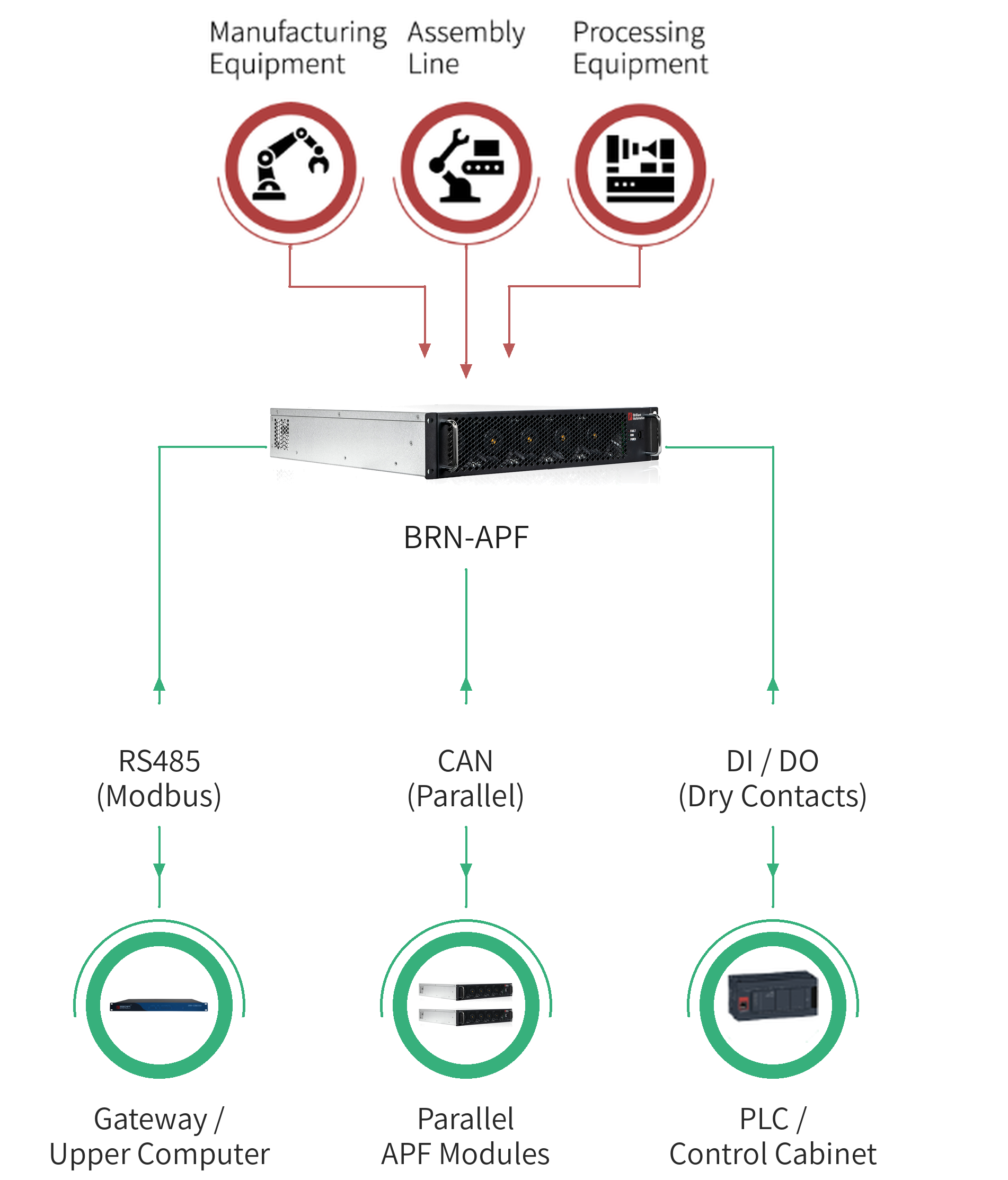
- Display & Communication: Optional no screen / 4.3-inch / 7-inch display, equipped with RS485 and CAN communication ports (RJ45), supporting multi-unit parallel connection (≤ 20 modules in parallel, ≤ 8 under HMI control).
- Protection & Safety: Automatic detection and recording of CT disconnection and phase sequence reversal, supporting comprehensive protection functions including over-voltage, under-voltage, over-frequency, under-frequency, over-temperature, and bus imbalance.
Overview
GB/T 14549-1993 is a national standard issued by the State Bureau of Technical Supervision of China, titled "Power Quality - Harmonics in Public Supply Network." This standard aims to provide unified specifications for harmonic voltage limits, allowable harmonic current values, and harmonic measurement methods for public supply networks in AC power systems. It is an important basis for evaluating and managing harmonic pollution in the power grid and ensuring the safe and economical operation of the power system. The design and harmonic filtering performance of the BRN-APF strictly follow this standard, ensuring that the power quality after grid connection meets the harmonic requirements of the public supply network.
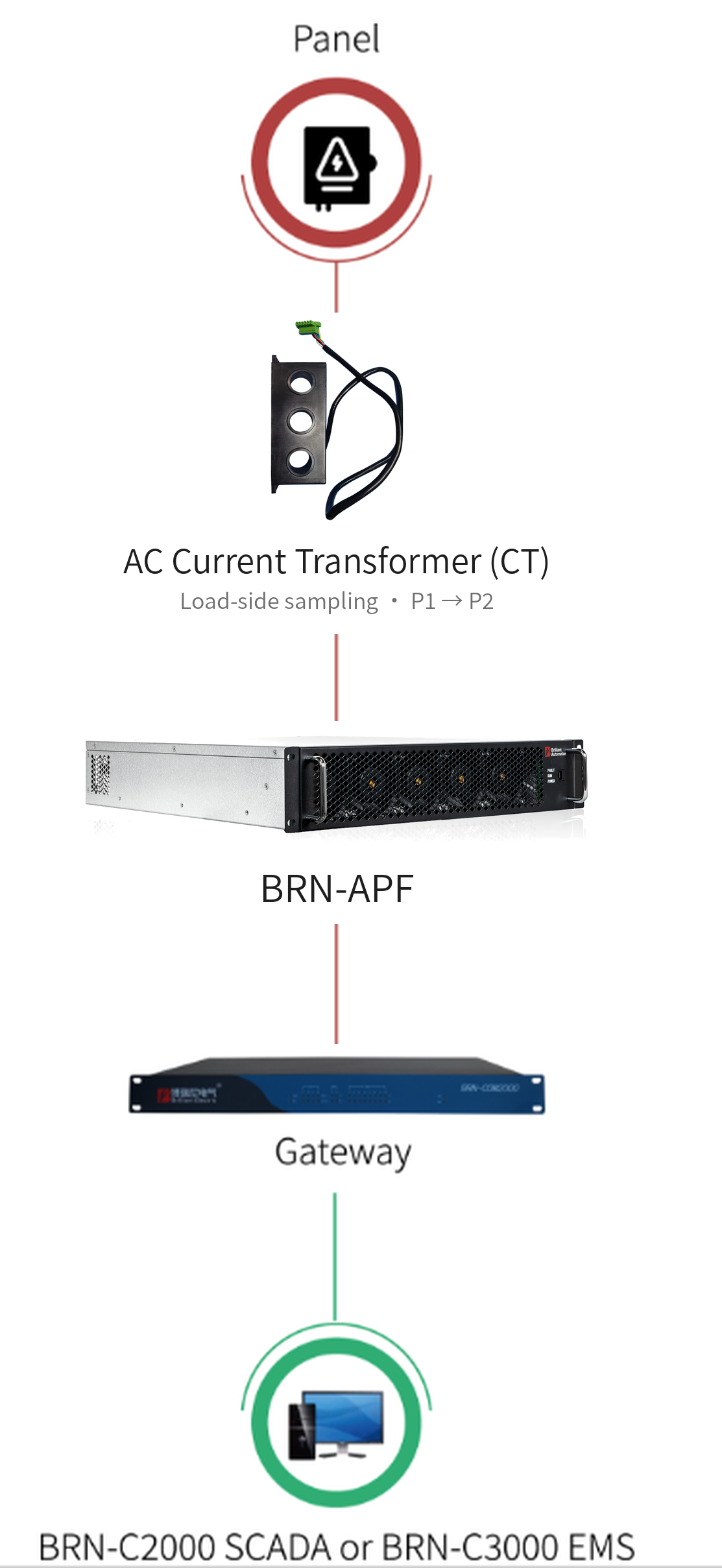
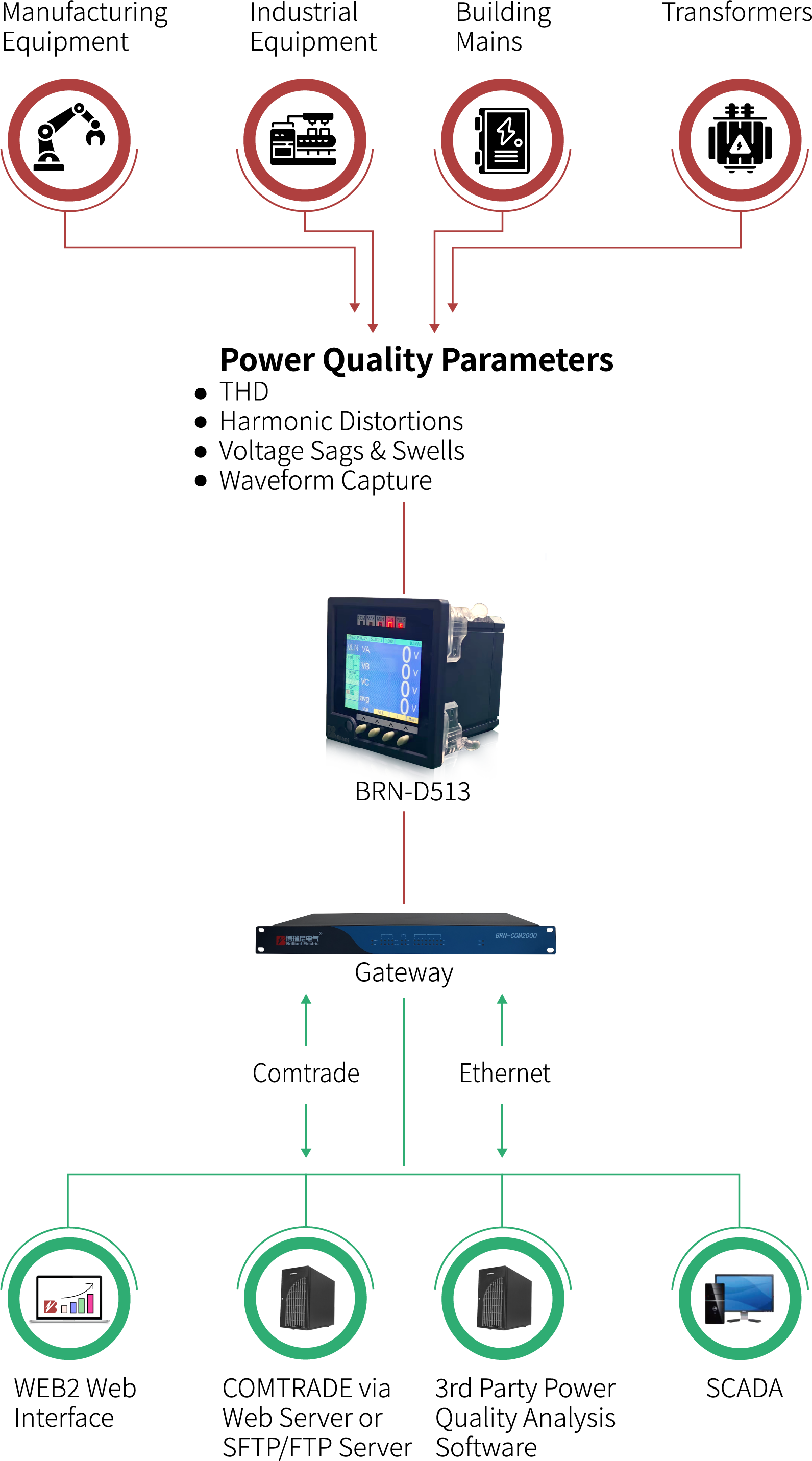
Diagram
Reference wiring and deployment views for installation planning and system integration.
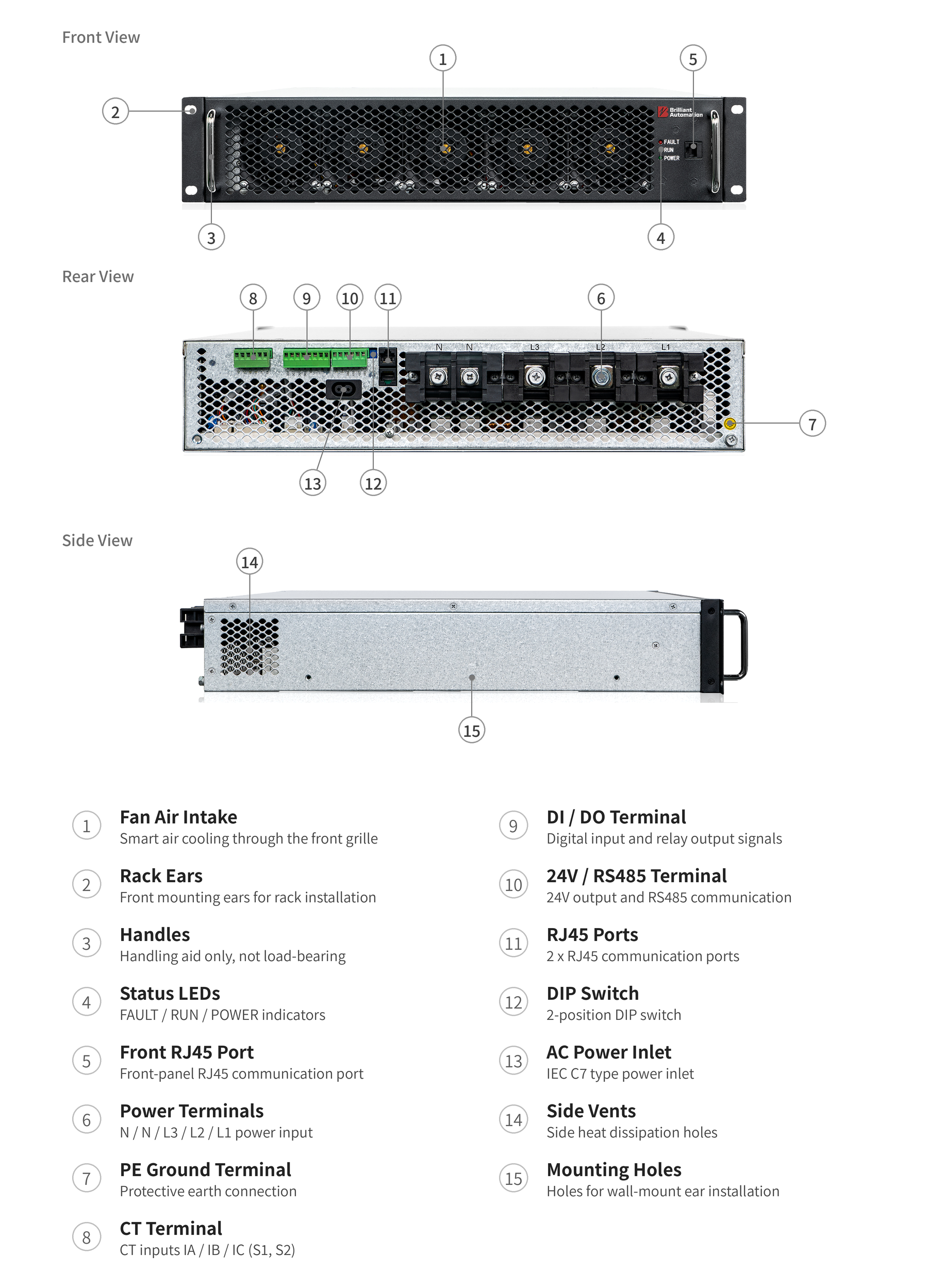
Product Map
Hardware layout reference for interface identification and installation planning.
Key Specs
Core performance highlights for specification review and project planning.
Filtering & Compensation Performance
Supports selectable 2nd to 50th order harmonic filtering (filtering capability better than 97% at rated load), response time ≤ 10 ms, and simultaneously supports reactive power compensation and three-phase imbalance governance.
Overload & Topology
Utilizes three-level topology, supporting 110% rated current for continuous operation and 120% rated current for 1 minute, adapting to various complex industrial loads.
Display & Communication
Optional no screen / 4.3-inch / 7-inch display, equipped with RS485 and CAN communication ports, supporting multi-unit parallel connection (≤ 20 modules in parallel, ≤ 8 under HMI control).
Protection & Safety
Automatic detection and recording of CT disconnection and phase sequence reversal, supporting comprehensive protection functions including over-voltage, under-voltage, over-frequency, under-frequency, over-temperature, and bus imbalance.
Related Industries
Software workflows for dispatch, forecasting, planning, and grid reliability.




Accessories
Operation Panel
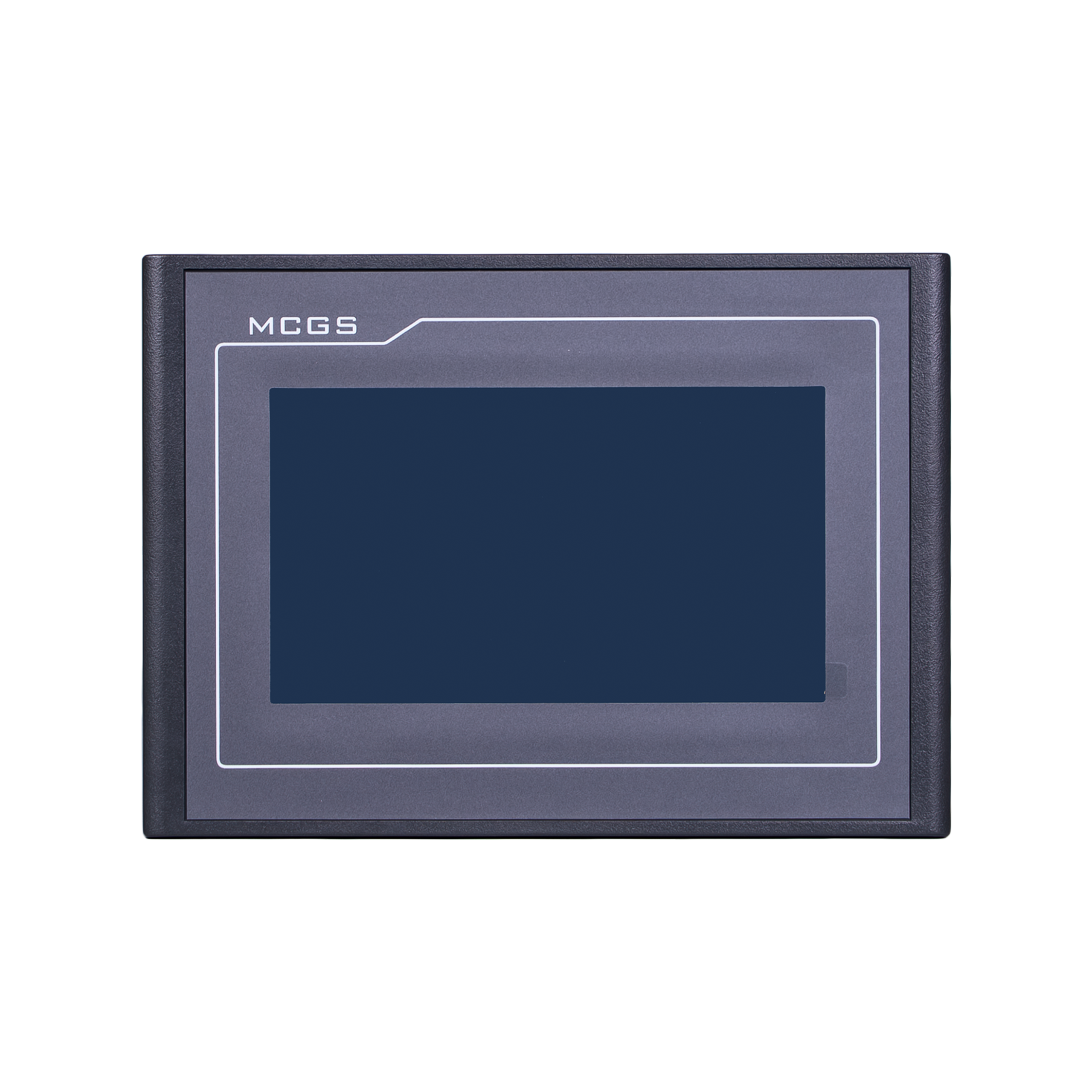
The BRN-SVG and BRN-APF series from BRN are equipped with a high-performance industrial HMI touch panel as standard. It integrates real-time data display, parameter configuration, fault recording, and status monitoring. With an intuitive interface, easy operation, multi-language support, and excellent EMC performance, it ensures stable operation in complex power distribution environments and delivers an efficient, intelligent HMI experience.
USB-to-RS485 Converter
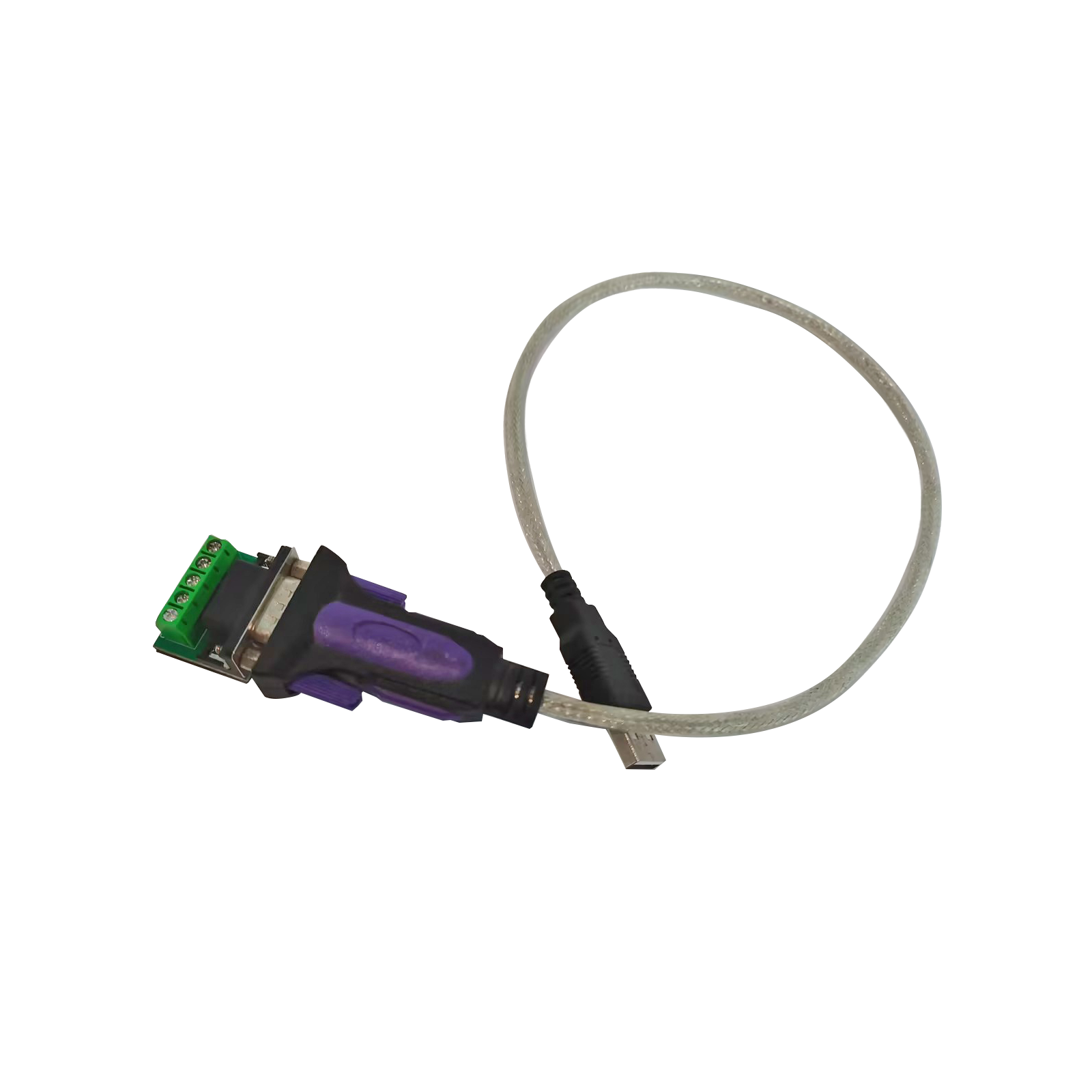
This plug-and-play USB to Serial RS485 Converter is designed to provide a convenient and reliable connection from Acuvim II meters to other devices with a USB port.
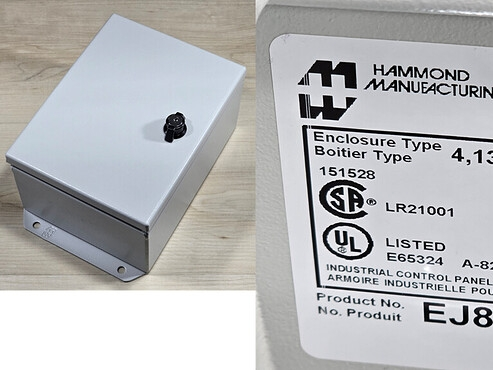
UL 508A Panel Shop
Pre-configured, pre-wired panel solution is ideal for on-site installations need to meet regional regulatory safety and environmental compliance. All panels are quality tested to be reliable and fault-free.
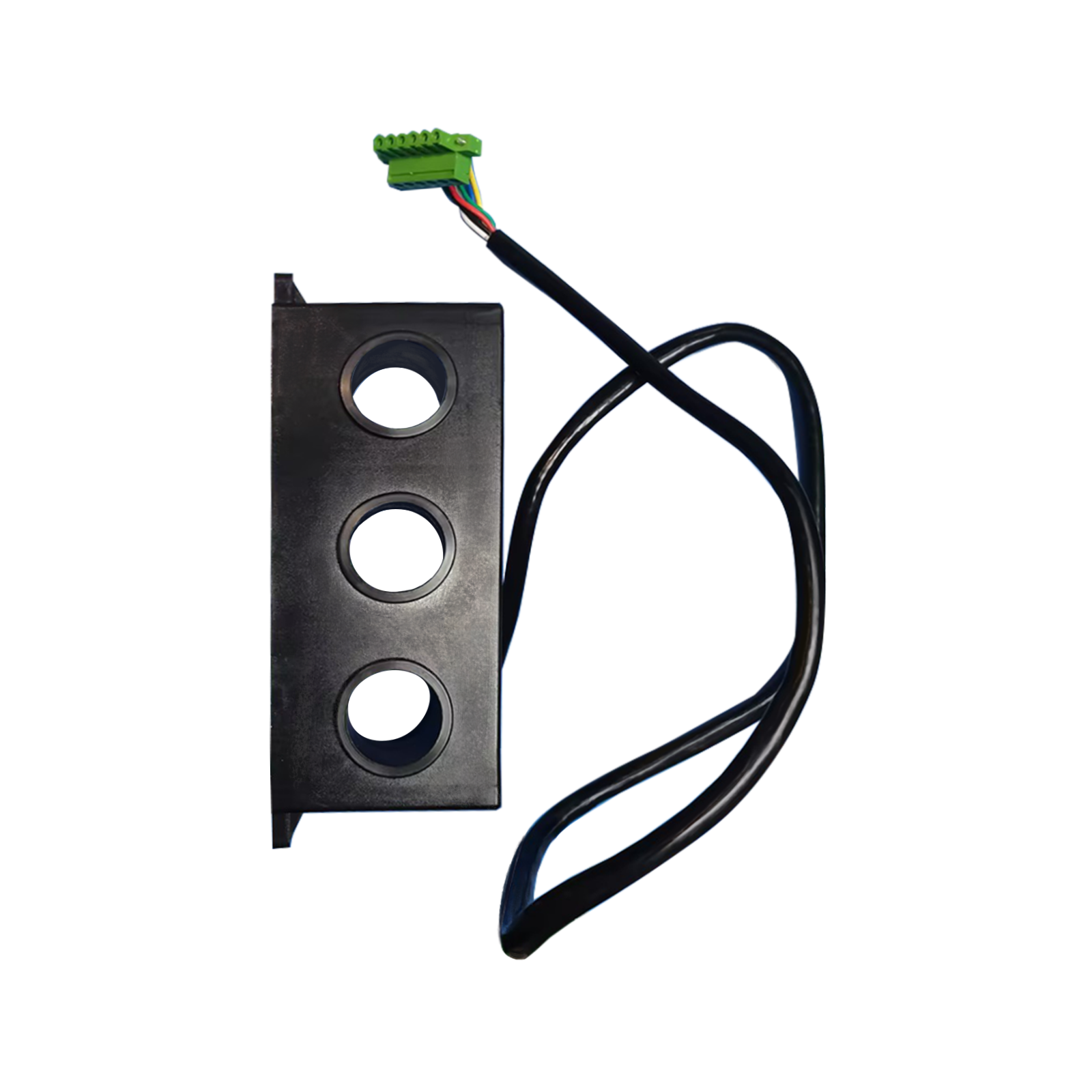
AC Current Transformers
An AC current transformer (CT) is a crucial measuring device in power systems. Operating on the principle of electromagnetic induction, it proportionally converts high primary currents into standardized low secondary currents (typically 5A or 1A) for use by meters and protective relays. Its primary functions are to provide electrical isolation from high-voltage circuits, ensuring safety, and to extend the range of measuring instruments. It is an essential component for power monitoring and revenue metering.
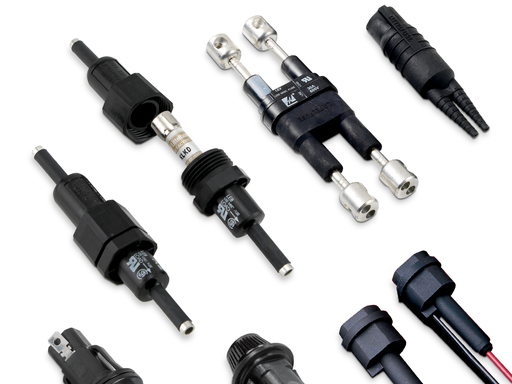
Inline Fuse
In-line fuse holders are used in places with spatial constraints to provide circuit protection in the event of a fault. It is designed to be safe to the touch and flexible for use in different types of applications.
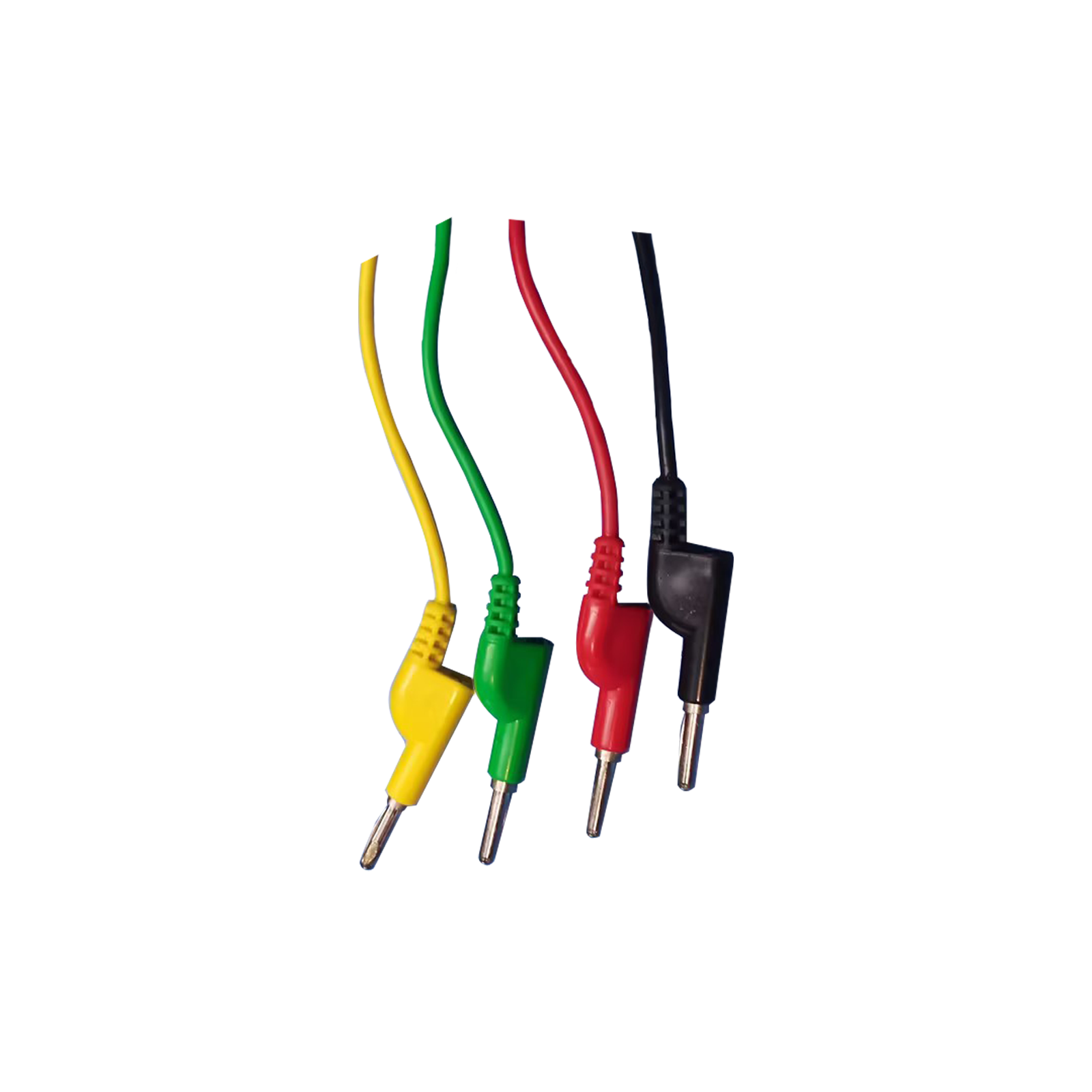
Test Lead & Voltage Clip
A 4-color (yellow, green, red, black) test lead set featuring standard banana plugs for secure connections and durable flexible insulation. Specially designed for voltage measurement, circuit testing, and multi-channel wiring. The bright color-coding ensures quick identification, making it an essential diagnostic tool for engineers and electronics enthusiasts.
Frequently Asked Questions
Common questions on wiring, setup, and commissioning.
An Active Power Filter is a dynamic power quality management device based on modern microprocessors and digital signal processing technology. It can real-time detect harmonic currents and reactive components in the power grid, and actively output compensation currents with equal amplitude and opposite phase through IGBT power modules, thereby achieving precise filtering of the 2nd to 50th order harmonics (filtering capability better than 97% at rated load), reactive power compensation, and three-phase imbalance governance. It enables全天候 continuous monitoring and dynamic compensation, providing accurate data for power quality assessment, fault diagnosis, and grid optimization.
Traditional passive filters (such as LC filters or capacitor banks) can only perform fixed compensation for specific harmonic orders, are prone to resonance with the power grid, and their compensation effect is greatly affected by grid impedance. In contrast, the BRN-APF adopts an active compensation method, dynamically tracking and filtering 2nd to 50th order harmonics, while supporting reactive power compensation and three-phase imbalance governance, with a response time of ≤ 10 ms. It does not resonate with the power grid and adapts to complex and variable industrial loads.
Yes. By filtering harmonics, compensating reactive power, and governing three-phase imbalance, the BRN-APF can effectively reduce line losses, improve transformer utilization, reduce power factor penalty charges, and extend equipment service life, thereby significantly lowering overall energy costs.
The CT is a critical external component for the normal operation of the APF system, used to real-time collect current signals from the grid or load side. Based on the current waveform collected by the CT, the APF analyzes the harmonic and reactive components and outputs corresponding compensation currents. If the CT wiring is incorrect, it may result in insufficient filtering effect or equipment failure.
The selection of the CT ratio is crucial. It is generally recommended to select the CT ratio at 1.2 to 1.5 times the system current. In practical engineering, it can also be selected at 1.5 times the transformer capacity (400V). For example, if the transformer capacity is 2000 kVA, a 3000/5 CT can be selected. An improper CT ratio will affect the sampling accuracy and compensation effect of the APF. Please be sure to refer to the manual for selection guidance.
The BRN-APF supports sampling on either the grid side or the load side. It is recommended to install the external CT on the load side, which allows for more accurate detection of harmonics and reactive currents generated by the load, thereby achieving more precise compensation. The specific installation location should be determined based on actual site conditions and system configuration.
Common installation errors include: reversed A/B/C/N phase sequence, incorrect CT wiring polarity (S1/S2 reversed), open CT secondary circuit, unreliable PE grounding, communication cables between modules not connected according to the "top-to-top, bottom-to-bottom" principle, and installation environment not meeting requirements (such as humid, dusty, high-temperature conditions). These errors may cause equipment damage or poor compensation performance.
Before installation, please read the user manual carefully to ensure correct and secure A/B/C/N/PE wiring, correct CT polarity and direction, and communication cable connections complying with specifications. Before first power-on, use a multimeter to check for short circuits, confirm the phase sequence is positive (A→B→C→N), and ensure the CT is in a short-circuited state until wiring is complete. During commissioning, please verify through the screen that parameters such as CT ratio, CT position, and CT direction are correctly set.
Before first power-on, check: whether the equipment is securely installed; whether A/B/C/N connections are correct with no missing or mixed connections; whether PE is reliably grounded; whether the phase-to-phase distance is ≥ 15 mm; whether there is any short circuit; whether CT wiring is correct and one-to-one corresponding; whether the isolation switch is correctly installed and in the disconnected state; whether the installation environment meets requirements; and whether the phase sequence is positive.
Yes. The number of BRN-APF modules in parallel is ≤ 20, and the number under HMI control is ≤ 8. During parallel connection, communication cables must follow the "top-to-top, bottom-to-bottom" connection principle, and one master and multiple slaves must be configured. Modules of different capacities (such as 100A + 50A) can also be connected in parallel, with the same connection method as modules of the same capacity.
The response time of the BRN-APF is ≤ 10 ms, enabling rapid tracking and compensation of harmonic and reactive current changes in the power grid. It is suitable for scenarios with high power quality requirements, such as industrial automation and data centers.
The BRN-APF supports 110% rated current for continuous operation and 120% rated current for 1 minute. This overload capability enables it to adapt to industrial environments with large load fluctuations.
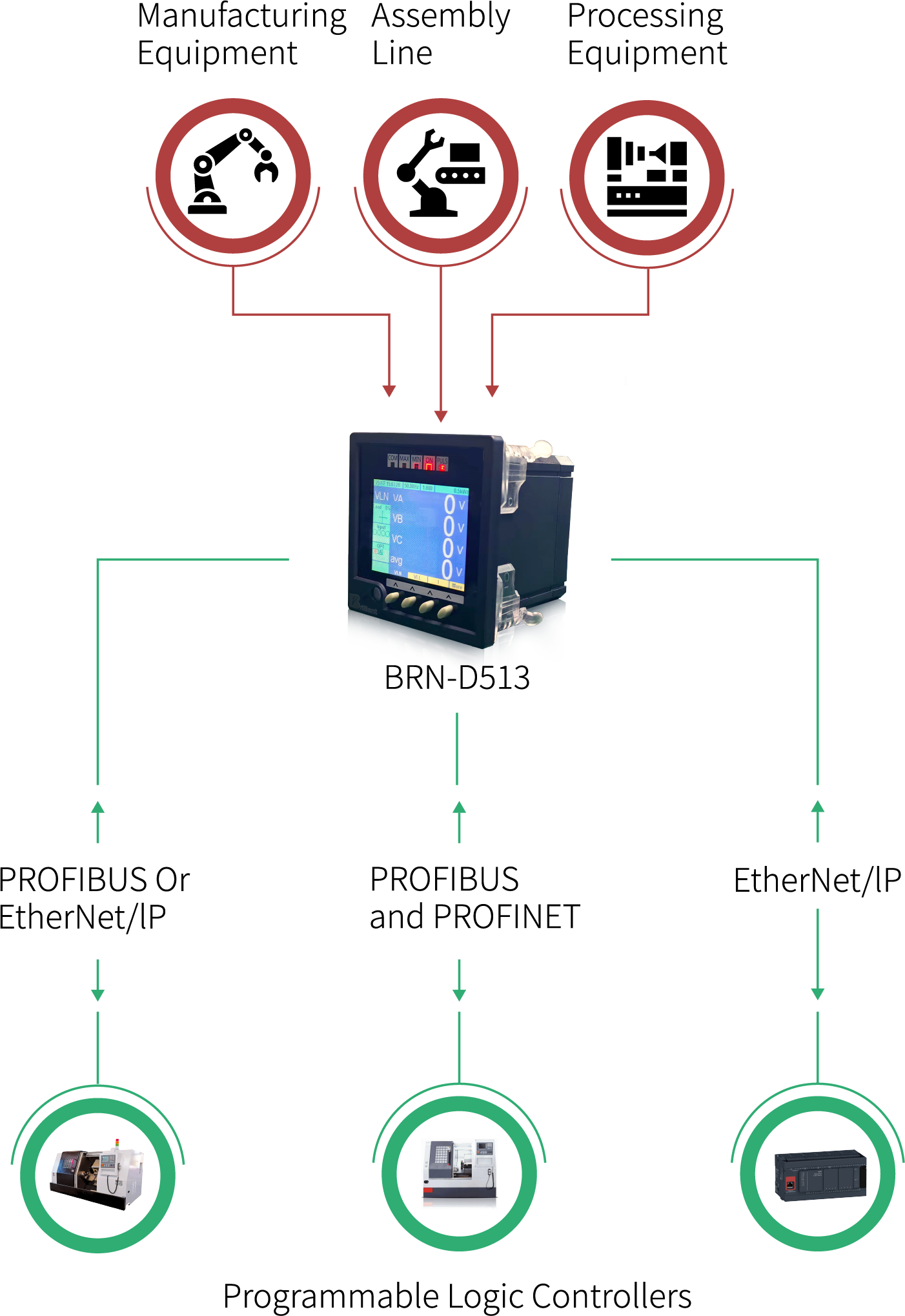
The BRN-APF is equipped with RS485 and CAN communication ports (RJ45) and supports the Modbus protocol. It can be integrated with upper computer systems such as SCADA, BMS, and EMS for remote monitoring and data forwarding.
The protection level of the BRN-APF is IP20, and it adopts intelligent air cooling. During installation, ensure at least 30 cm of heat dissipation space is reserved on all sides (front, back, left, and right), and that the air inlet and outlet are unobstructed.
The BRN-APF features comprehensive fault self-diagnosis. Fault information can be viewed through the 4.3-inch or 7-inch screen. Common faults include: EPO emergency stop, IGBT overcurrent, DC bus overvoltage, module overcurrent, fan failure, over-temperature, phase loss, phase sequence error, etc. Users can reset or check according to on-screen prompts. If the fault cannot be resolved, please contact the manufacturer's professional technical personnel in time. Do not disassemble or modify parameters without authorization.
Request a Quote
Need pricing, lead time, or project recommendations? Submit your inquiry and our team will reply shortly.
Go to Inquiry Form